Steps in Conducting Grounded Theory Research and Evaluations for a Grounded Theory Design

Related image

According to Creswell and Guetterman (2019), eight steps are suggested to conduct a grounded theory research, especially if the research conforms to the systematic research design. Researchers taking emerging and constructivist design “might engage in alternative procedures” (Creswell & Guetterman, 2019, p. 452).

Step 1. Decide if a grounded theory design best addresses the research problem

The first step of conducting a grounded theory is to determine if grounded theory will answer the research question.

Grounded theory is good to use when there are no exiting theories or limited theories regarding the process that’s of interest to the researcher; or there are theories that exist but they were created for a certain group of people that the research researcher is interested in.

For example, let’s say that there is no theory that exists in terms of the process of becoming a regular smoker while attending high school or college. A researcher might think what theoretical model could best describe the process of becoming a smoker in high school and college.

Step 2. Identify a Process to Study

The researcher needs to “identify early on a tentative process to examine the grounded theory study” (Creswell & Guetterman, 2019, p.452), although this process may be modified later in the study. “The process should naturally follow from the research problem and questions that the researcher seeks to answer” (Creswell & Guetterman, 2019, p.452).

Step 3. Seek Approval and Access

Ethical issues are always significant when it comes to conducting a study. Approval must be obtained from the institutional review board and from the individuals who will participate in the study before starting the research. For more details about ethical issues, please check out Chapter 7 – Collecting Qualitative Data (Creswell & Guetterman, 2019, p.229-233).

Step 4. Conduct Theoretical Sampling

The researcher then recruits participants who have experienced or are going through the process of interest, which is as known as theoretical sampling—finding a sample of participants who have experienced the process that the researcher is interested in and can help develop a well founded theory. So in our example, it could be good to recruit smokers and former smokers in high schools and colleges.

Step 5. Code the Data

“The process of coding data occurs during data collection so that you can determine what data to collect next” (Creswell & Guetterman, 2019, p. 453).

It usually starts with the identification of open coding categories and using the constant comparative analysis for saturation by comparing data and categories. Based on open coding, the researcher moves to axial coding and generates a coding paradigm, while causal conditions, intervening and contextual categories, strategies, and consequences are identified.

Step 6. Use Selective Coding and Develop the Theory

This step involves the actual development of the theory, including interrelating the categories in the coding paradigm, refining the axial coding paradigm, and presenting it as a model. Or, the researcher can write in a narrative that describes the interrelationships among categories (Creswell & Guetterman, 2019, p.453).

Step 7. Validate Your Theory

It is important in the process to validate the findings, where the researcher actually checks to see if the data collected is reliable.

Based on the methods demonstrated by Creswell and Guetterman (2019) in Chapter 8 Analyzing and Interpreting Qualitative Data in the textbook, there are a couple of ways doing that.

One is member checking – to go back and talk to the individuals who have been interviewed to confirm the data collected accurately interprets their experience.

Apart from that, the researcher can collaborate from different individuals who are outside of your particular study but who might have expertise, and look at other ways that the data has been collected in the field and described as a way of validating the research, which is known as triangulation.

Alternatively, researchers can conduct discriminant sampling, where they “poses questions that relate the categories and then returns to the data and looks for evidence, incidents and events to develop a theory”; after developing a theory, the researchers “validates the process by comparing it with existing processes found in the literature” (Creswell & Guetterman, 2019, p.454).

Step 8. Write a Grounded Theory Research Report

“The structure of the grounded theory report will vary from a flexible structure in the emerging and constructivist design to a more quantitative oriented structured in the systematic design”. (Creswell & Guetterman, 2019, p.454). It includes a problem, methods, discussion, and results; it reports the researcher’s “abstraction of the process under examination” (Creswell & Guetterman, 2019, p.454).

Image result for conducting grounded theory

How to Evaluate Grounded Theory Research

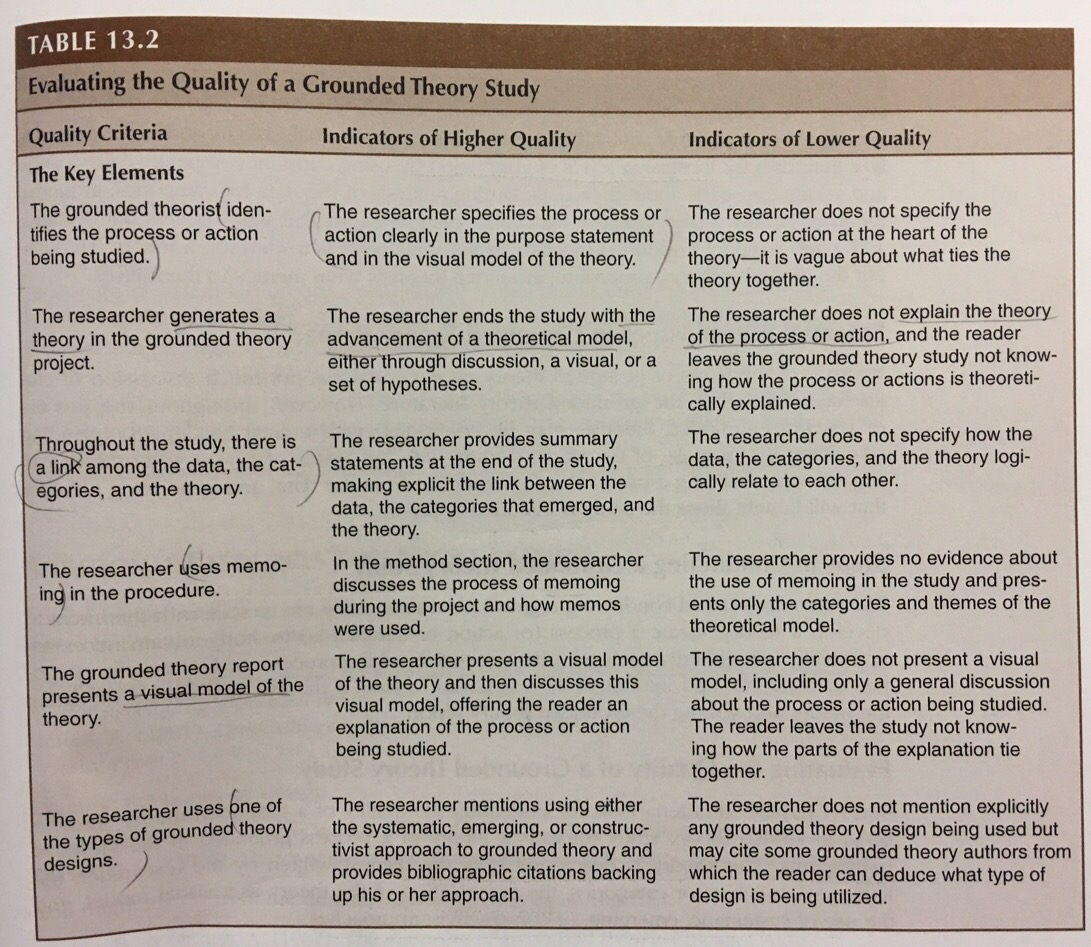
Criteria for evaluating a grounded theory research is shown in the picture below (Table 13.2, Creswell & Guetterman, 2019, p.455).
Strengths of the grounded theory

  • Can use multiple types of data
  • Provides an in-depth perspective
  • New theories can emerge from coding the data into categories

The limitations of grounded theory

  • Hard to recruit participants, depending on the process of interest
  • Time to gather data
  • Analysis can be difficult
  • There may be researcher bias
  • Researchers can feel ambiguous while conducting the study and the next step can be unknown
  • To conduct a grounded theory, researchers must have patience.

The limitation with grounded theory can be hard to recruit participants depending on the process; it can take a lot of time to gather data, to analyze data, to come up with your model, etc. Data analysis can be difficult. It can be difficult to categorize and code all of that data; and there may be researcher bias in terms of the study and what categories are.

Moreover, because of small samples of participants, can we really say that their experience with that process is what has been felt by others although discriminant analysis helps to verify the model. If we are only dealing with a small number of participants in a particular area of the country, it can be problematic to claim that their experience with a certain process can really fully be pictured in a model and be applied to everyone else in the world.

Reference

Creswell, J. W. & Guetterman, T. C. (2019). Educational research: Planning, conducting, and evaluating quantitative and qualitative research (6th ed.). Boston: Pearson.
The Key Characteristics of Grounded Theory Research

Image result for grounded theory

According to Creswell and Guetterman (2019), six characteristics that grounded theory researchers use in their designs: process approach, theoretical sampling, constant comparative data analysis, a core category, theory generation and memos. We already discussed constant comparative data analysis and memos in my previous post, so in this post we will look at the other 4 trails.

1. Process Approach

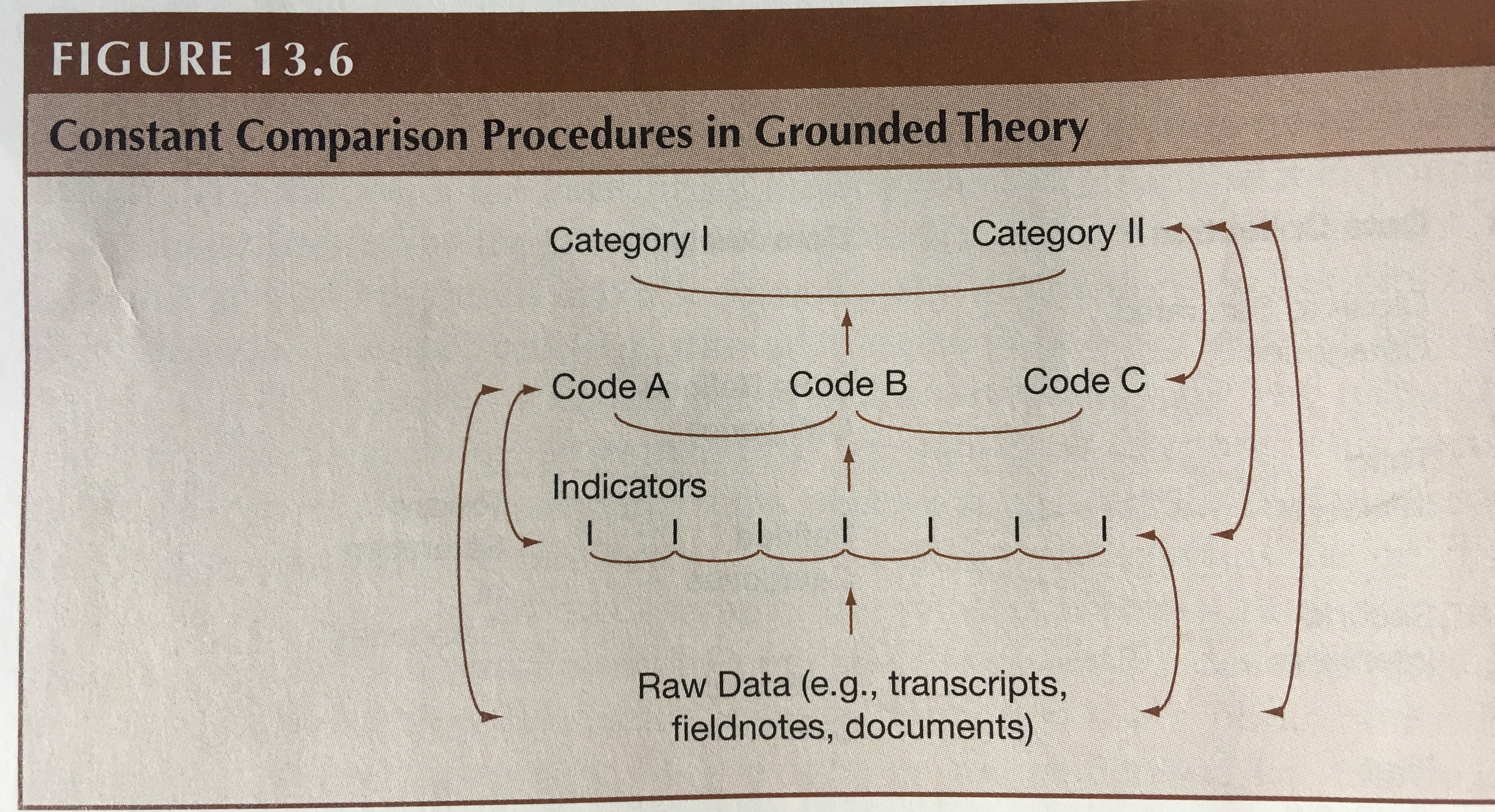
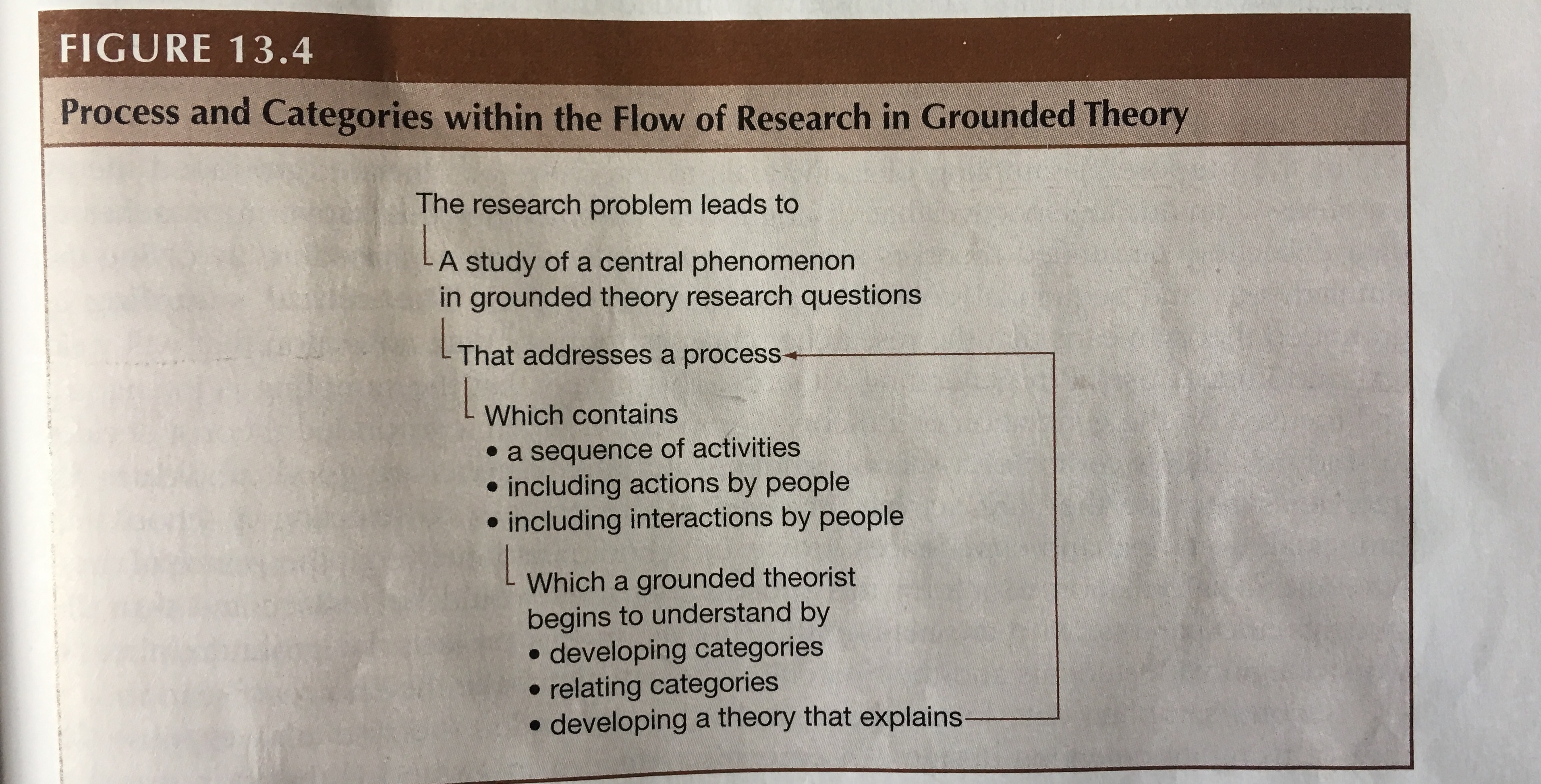
A core trait of grounded theory is its use to examine a process. A process is a sequence of actions among people. As a grounded theory research breaks down the process into steps, these steps become know as categories. The categories can be further broken down into codes. The whole procedure is shown in the picture above – Figure 13.4 (Creswell & Guetterman, 2019, p. 443).

For example, let’s say a researcher wants to develop a grounded theory about the “process of dropping out of college.” This study would involve describing the steps that lead a person to drop out of college. The various steps in this process would come from interviewing students who have dropped out of college (who have experiences in what the researcher wants to explore) to determine the order of events the precipitated dropout.

2. Theoretical Sampling

Theoretical sampling involves selecting data to collect, based on its use in developing a theory, including observations, conversations, interviews, public records, respondents’ diaries and journals, and the researcher’s own personal reflections (Charmaz, 2000, as cited by Creswell & Guetterman, 2019) . A grounded theory researcher is always seeking to find data that would be useful in the generating a theory.

Let’s come back to the example of dropout in college taken earlier. The researcher may choose to collect data from student who have dropped out, teachers, and parents. The reason for selecting these participants is that the researcher may be convinced that these participants have useful information in developing a theory.

It is important to use theoretical sampling while the theory emerges. A grounded theory researcher is constantly collecting and analyzing data simultaneously. This process is mutually beneficial because the sampling helps the analysis while the analysis helps to focus the sampling (Creswell & Guetterman, 2019, p.444-445).

Data collection does not stop until the data becomes saturated. Saturation (I will talk about this term later) is the point that new data will not provide any additional information. At what point this happens is at the discretion of the researcher.

Saturation

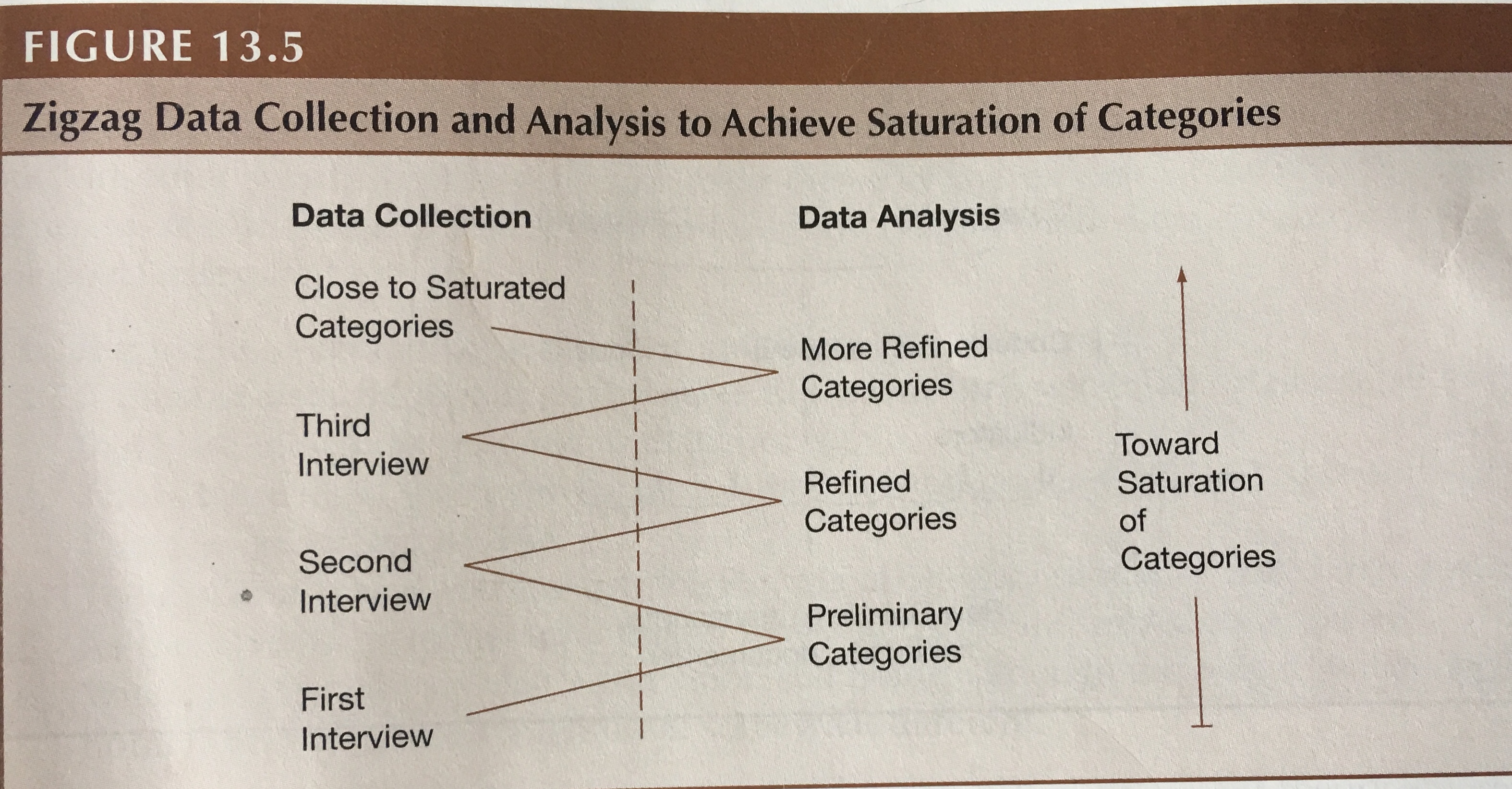
Let’s look at the picture above (Figure 13.5, Creswell & Guetterman, 2019, p. 445), the researcher would organize transcripts from the interview conducted; then the researcher would read through those transcripts to gain a general sense of the participants’ idea. After that, the researcher will start coding the transcripts and breaking them up into chunks; then the researcher describes the data in various ways. Then the researcher starts the beginning to develop categories, in which the process is called an iterative process, meaning that the researcher keeps going through the process over and over again. To reach the saturation, researchers prepare, read, code, then go through it again and again. Then the researcher conduct more interviews and more coding. Grounded theory researchers constantly collect data until they feel like that they have had enough, and then they interpret the data and start to develop categories. After that, the researcher collapse codes together to make themes. Different themes would be created and researchers keeps going through this process over and over again until they think the themes generated will describe that the central phenomenon.

3. Constant Comparative Data Analysis

We have talked about this in last post.

4. A Core Category

“From among the major categories derived from the data, the grounded theorist selects a core category as the central phenomenon for the theory” (Creswell & Guetterman, 2019, p.446).

Criteria for choosing a core category:

  • All other major categories can relate to it
  • Appears frequently in the data
  • The connections between categories are logical and consistent.
  • The phrase used to describe the central category should be sufficiently abstract.
  • As the concept is refined, the theory grows in depth and explanatory power.
  • When conditions vary, the explanation still holds, although the way in which a phenomenon is expressed might look somewhat different.

(Creswell & Guetterman, 2019).

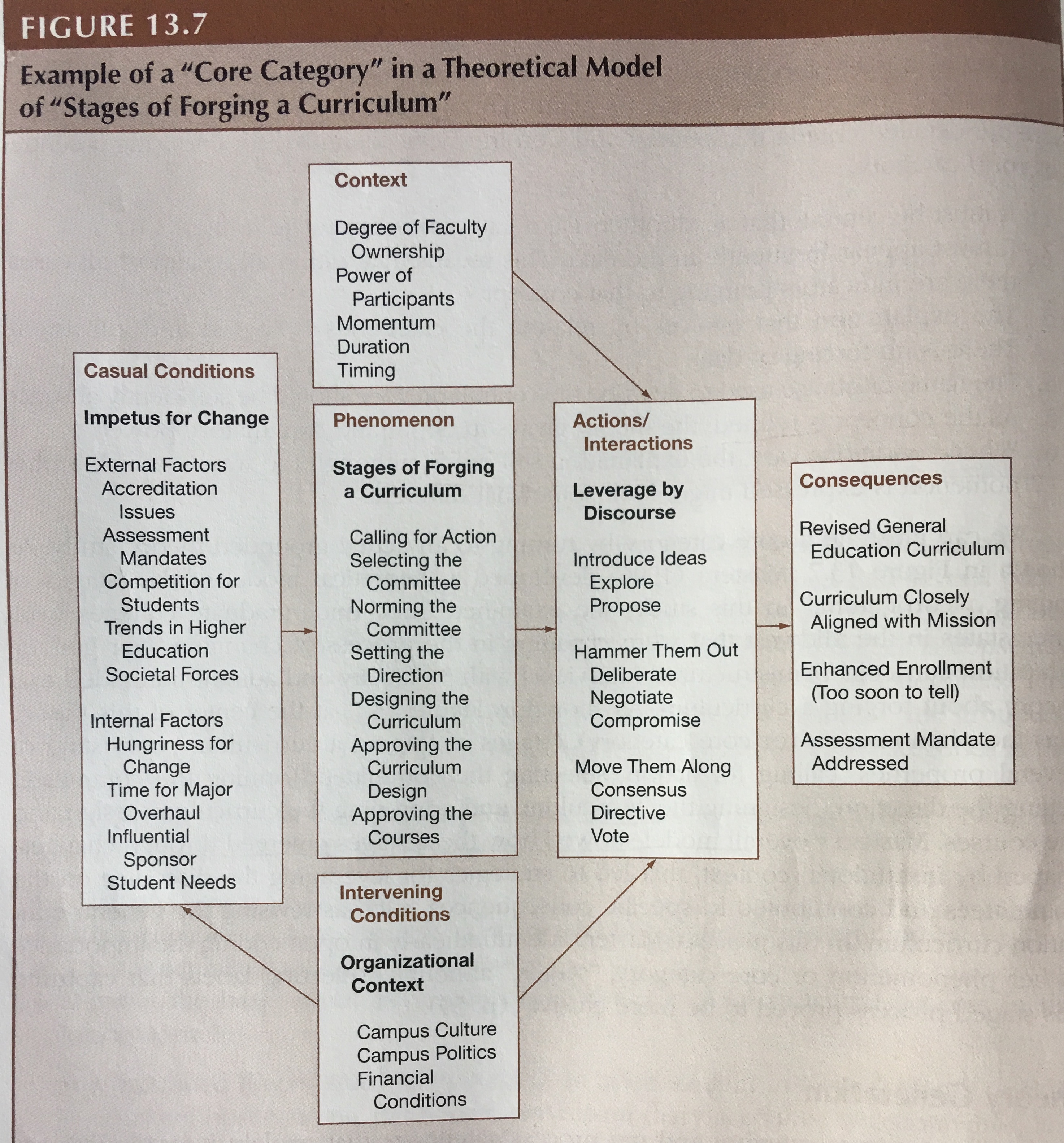
An example of how a core category is demonstrated in a theoretical model is offered in the textbook (Figure 13.7, Creswell & Guetterman, 2019, p.448).

5. Theory Generation

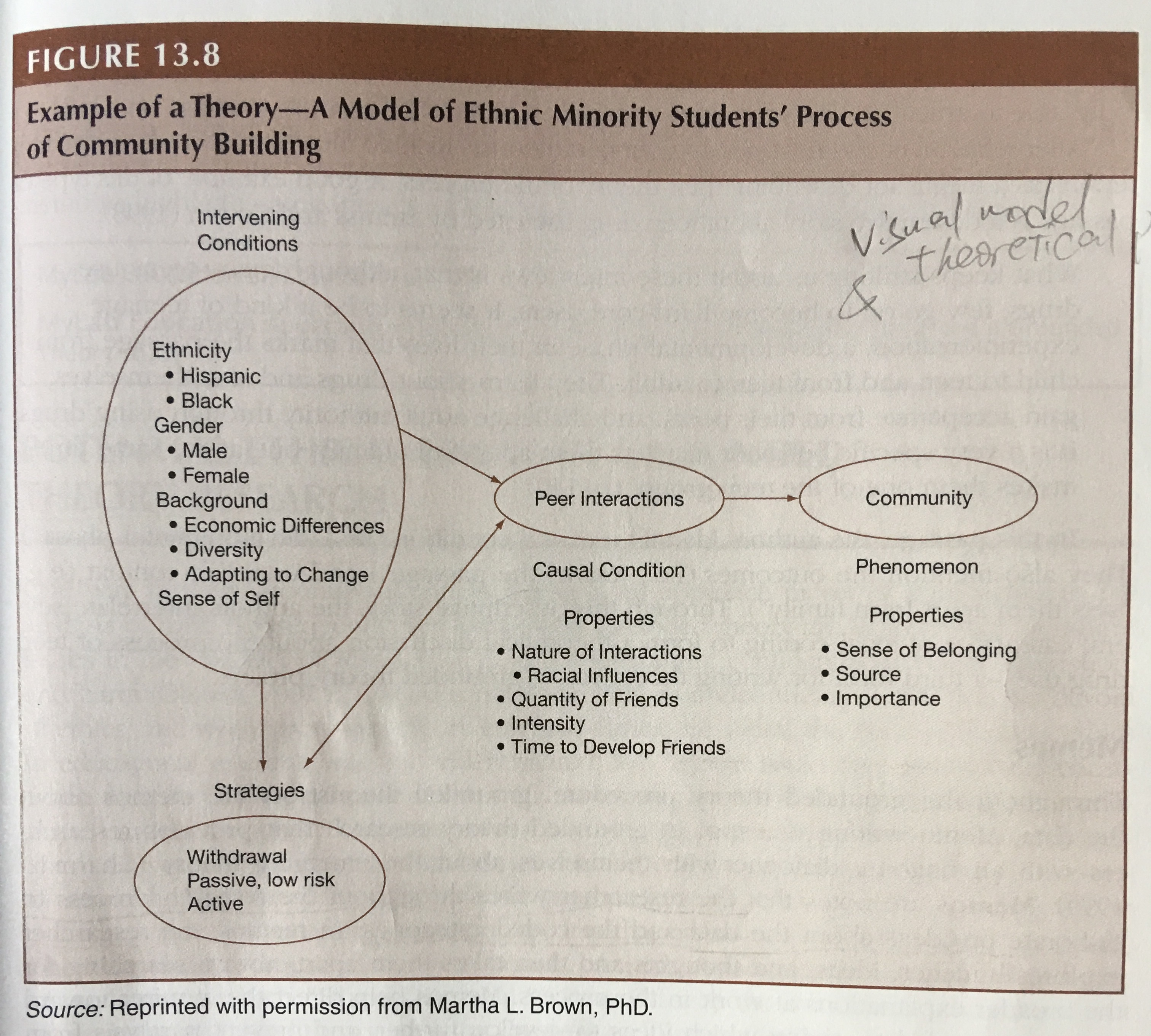
Theory appears in studies as the visual coding model or coding paradigm discussed in my previous posts; “it is an abstract explanation or understanding of a process about a substantive topic grounded in the data” (Creswell & Guetterman, 2019, p.447). Here is an example of a theory offered by the book (Figure 13.8, Creswell & Guetterman, 2019, p.449).

6. Memos

We talked about how to take memos in my last post.

References

Charmaz, K. (2000). Grounded theory: Objectivist and constructivist methods. In N.K> Denzin & Y. S. Lincoln (Eds.), Handbook of qualitative research (2nd ed., pp. 509-535). Thousand Oaks, CA: SAGE.

Creswell, J. W. & Guetterman, T. C. (2019). Educational research: Planning, conducting, and evaluating quantitative and qualitative research (6th ed.). Boston: Pearson.
Crook, T. A. (2013). A case study exploring the value and relevance of using the teaching ESL students in mainstream classrooms (TESMC) course for professional development related to teaching English to speakers of other languages with mainstream teachers of English language learners in international schools.

Three Types of Coding in Data Analysis in Grounded Theory

As what I introduced in my previous post, there are three phrases of analysis: open coding, axial coding, and selective coding, especially in the systematic design in grounded theory (Creswell & Guetterman, 2019). For the definition of these three coding approaches, please check out my previous post.

1. Open Coding—1st phrase of analysis

This image has an empty alt attribute; its file name is image.png

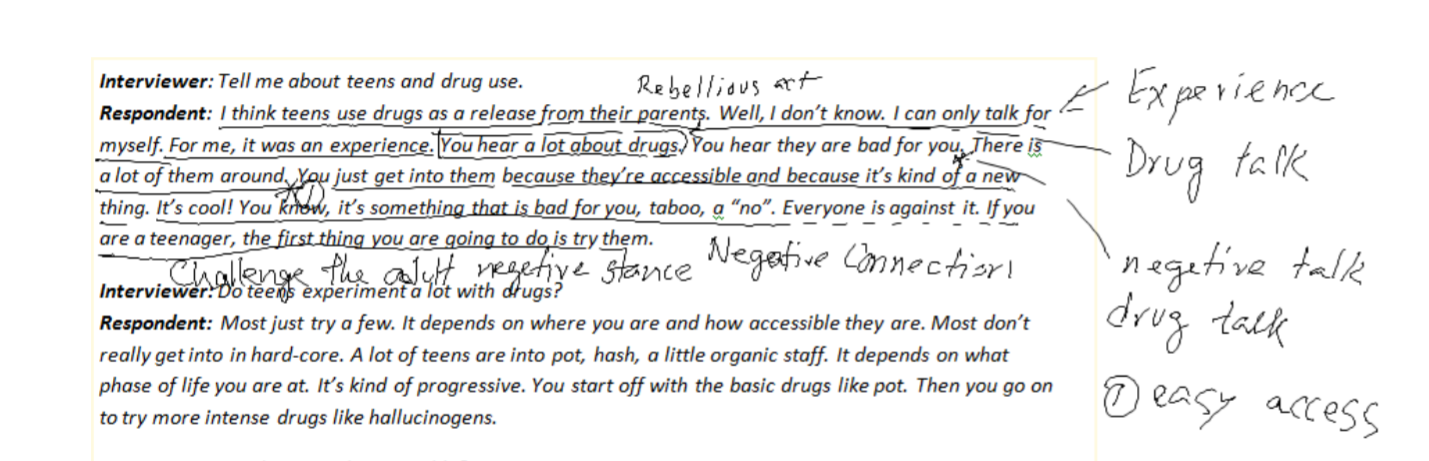
The image above is from Crook’s thesis (2013).

This is the first phrase of analysis – researchers reads the transcripts and determines different kinds of categories/themes/concepts (the three terms are the same thing but called differently by different researchers; for more details, see the footnote on p. 438, Creswell & Guetterman, 2019) that are found in the data. As explained in Chapter 8 in the textbook – Analyzing and Interpreting Qualitative Data, coding is when the researcher circles a chunk of text and write down the name of the category you have come up with next to that chunk of text (Creswell & Guetterman, 2019, p. 243-245).

Based on Miles, Huberman, and Saldana (2014), in this phrase, researchers should be open to what the participants are saying and open to the different types of categories that the researcher sees in the data.

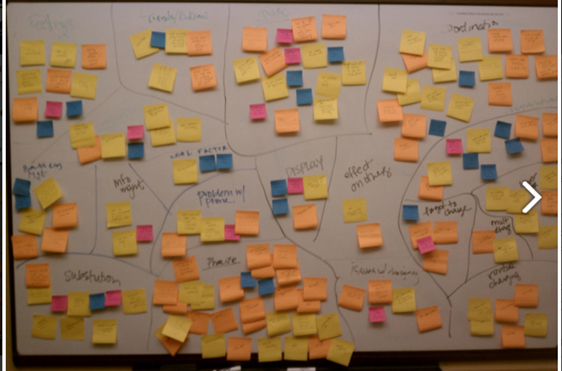
During open doing, researchers are also conducting constant comparative analysis (we will look at this later in this post), which is when researchers constantly compare the data to the categories to see if it is consistent in how the researcher codes the data in each category. If a new chunk of data doesn’t fit into a particular category, maybe the researcher needs to create a new category.

  • Constant Comparative Data Analysis

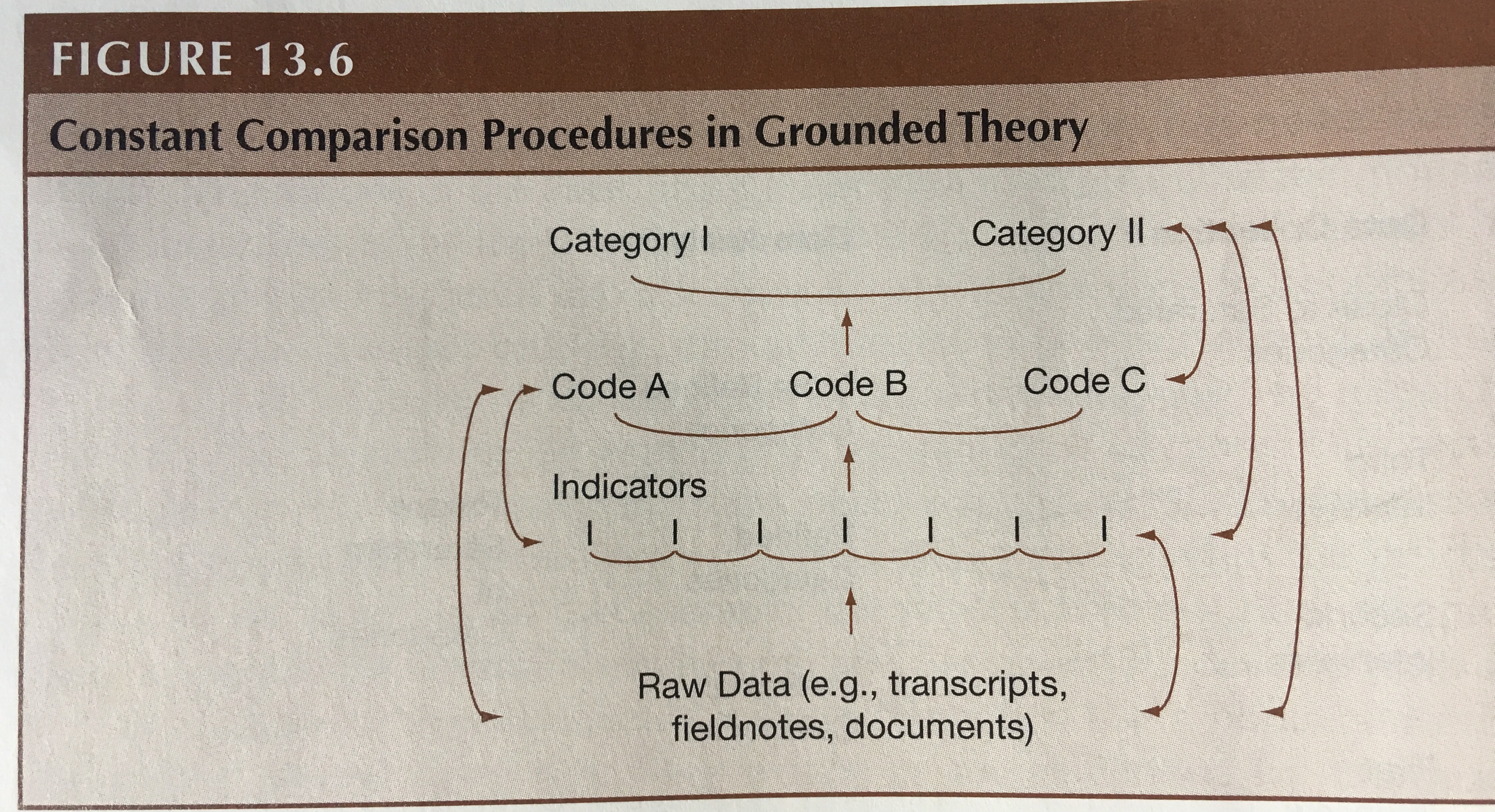
Constant comparison is an inductive data analysis procedure of generating and connecting categories” (Creswell & Guetterman, 2019, p. 445). The researcher compares data to other incidents, incidents categories, and categories to other categories to make sense of the data.

As information is coded and then put into categories, new information is compared to existing codes and categories. By comparing information constantly it allows for new codes and categories to emerge if current ones do not fit new data. In addition, codes and or categories that were separate may be combined as the data indicates.

During open doing researchers also make memos (please see the section of Memos later in this post) , which is when the researchers write notes to themselves throughout open coding regarding how the categories are beginning to explain the process and how these categories can be formed into a theoretical model.

  • Memos

Memos are the notes that the researcher writes throughout the research process to elaborate on ideas about the data and the coded categories” (Creswell & Guetterman, 2019, p. 450). Here is an example of taking memos (Figure 8.5) – it is a good idea to write the notes in the margins, which are located on the two sides of the paper (Creswell & Guetterman, 2019, p. 246).

Open coding is finished when the researcher feels that he has compared the data and categories to each other over and over that constant comparative analysis, and he feels like there are no new categories coming from the data; the researcher has read the transcript so many times that he is sure that he has found each major theme and there is no more things that can be made, so open coding is done and the researcher would say that the data at this point has been coded (Creswell & Guetterman, 2019, p. 445 & 453).

Key Points in Open Coding

Let’s conclude the steps in Open Coding:

  • Read transcripts and determine different categories that are in the data
  • Coding: circle a chunk of text and label it with a category name that it fits in
  • Constant comparative analysis: Researchers constantly compare data to the categories to determine consistency in coding the data.
  • Memos: notes that the researcher writes throughout the research process to elaborate on ideas about the data and the coded categories.
  • Open coding is completed when there are no more new categories coming from the data.

2. Axial Coding – 2nd phrase of analysis

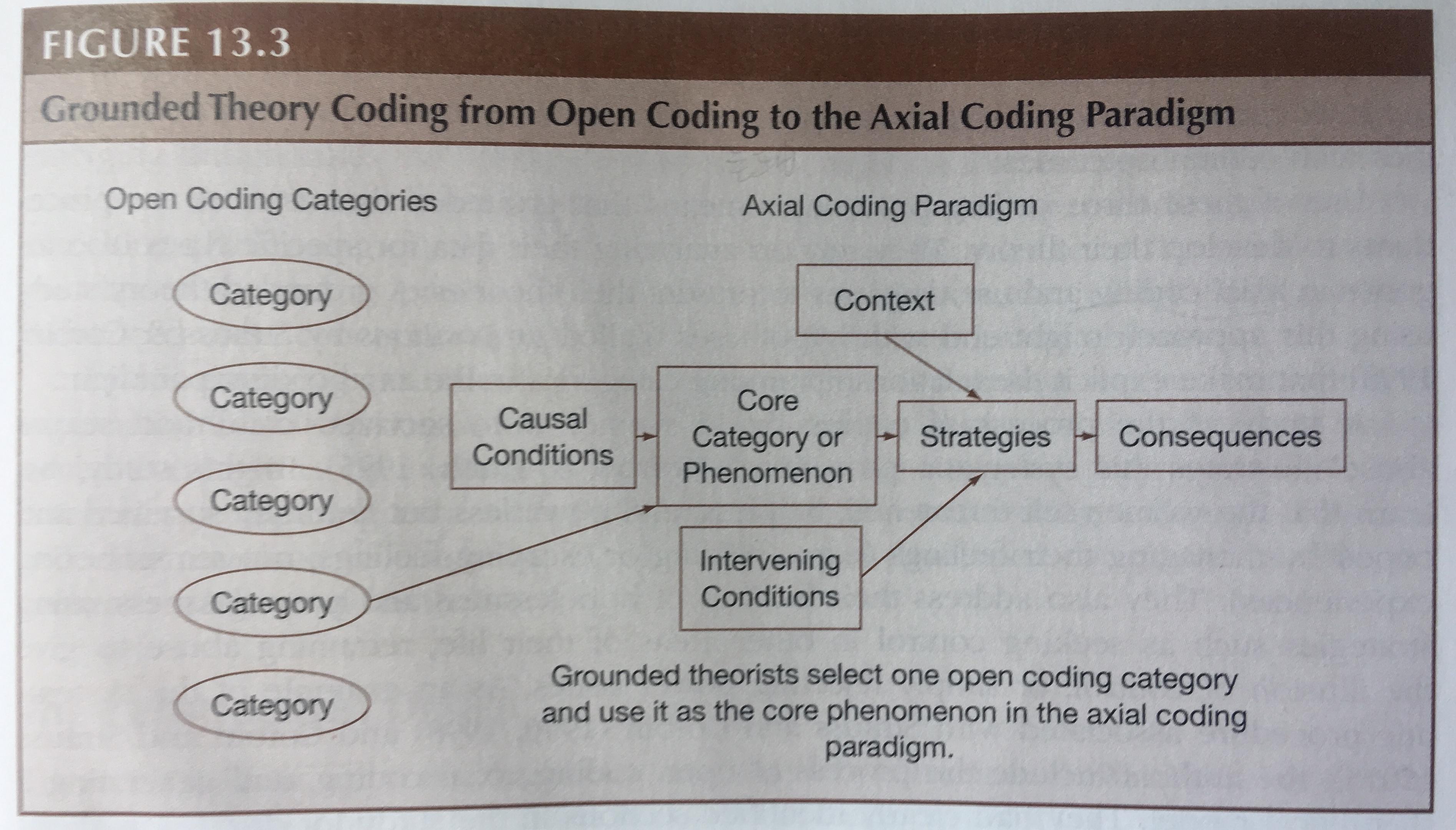
Axial coding is the next phrase. As shown in the picture above, Figure 13.3 (Creswell & Guetterman, 2019, p. 439), axial is when the researcher uses the codes to think about how each of the categories relate to each other. This is the part of the analysis that actually develops and forms the theory. The researcher looks for categories that may be the core phenomenon, causal conditions, strategies, and consequences and figure out how these categories connect to each other. Researchers show these relationships and connections through a coding paradigm or a logic diagram, which is a visual model that shows the categories with lines and arrows to show an explanation of how the process works.

Key Points in Axial Coding

  • The researcher uses the codes & memos to show how categories relate to each other.
  • Axial coding forms the theory: the researcher looks for categories that may be the core phenomenon, causal conditions, strategies, and consequences and connects these categories to each other.
  • Coding paradigm/logic diagram: visual model to explain how the process works.

3. Selective Coding – the last phrase of analysis

Selective coding is when the researchers write a storyline about how the theory explains the core process – how all the categories are related. It is an overall explanation of the theory.

Key Points in Selective Coding

  • Researchers write a story about how the theory explains the core process.
  • An overall explanation of the theory

References

Creswell, J. W. & Guetterman, T. C. (2019). Educational research: Planning, conducting, and evaluating quantitative and qualitative research (6th ed.). Boston: Pearson.
Crook, T. A. (2013). A case study exploring the value and relevance of using the teaching ESL students in mainstream classrooms (TESMC) course for professional development related to teaching English to speakers of other languages with mainstream teachers of English language learners in international schools.

Miles, M. B., Huberman, A. M., & Saldana, J. (2014). Qualitative data analysis: A methods sourcebook (3rd ed.). SAGE Publications.

Types of Grounded Theory Designs and Coding Methods

Three dominant types of grounded designs are introduced in the textbook by Creswell and Guetterman (2019): the systematic design by Strauss and Corbin (1998), the emergent design by Glaser (1992), and the constructivist design by Charmaz (1990, 2000, 2014). A comparison of the three designs (Table 13.1) is offered by the book (Creswell and Guetterman. 2019, p. 436).

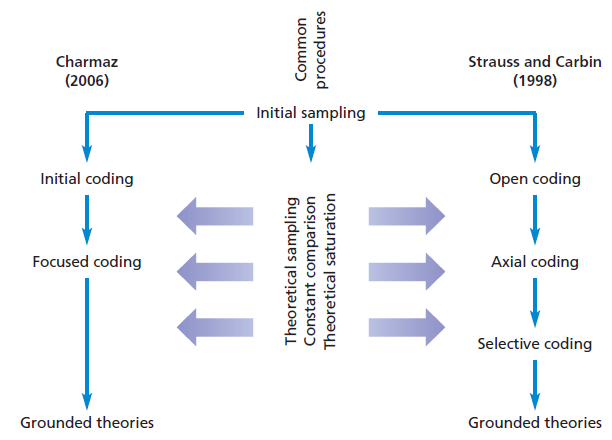
Although the book introduces the three coding methods before getting into the emerging design and the constructivist design, I think it is more comprehensible if we look at the 3 designs together then the 3 coding methods.

The picture above clearly shows how coding words in different grounded research designs. We will look at this in detail; now let’s just have a picture of the use of coding methods in grounded theory.

Three Grounded Theory Designs

1. The systematic Design

The definition of the systematic design in grounded theory by Creswell and Guetterman (2019) is quite inductive – “the use of data analysis steps of open, axial, and selective coding and the development of a logic paradigm or a visual picture of the theory generated” (p.436).

In the three phases of coding (open, axial and selective), the researcher starts with the most specific information they collected and summarize and move to the most abstract characteristics they were able to find through analyzing the data.

2. The Emerging Design

Compared to the systematic design proposed by Strauss and Corbin (1990), the emerging design by Glaser allows the theory to emerge from the data rather than forcing the data into preconceived categories. Glaser’s (1992) emerging design emphasizes on letting a theory emerge from the data. The generate theory should appropriately fit the data, should actually work, be relevant, and changeable when new data show up, which means in the process of the emerging design, the researcher collects data, immediately analyzes those data rather than waiting until all data are collected, and then bases the decision about what data to collect next on this analysis.

3. The Constructivist Design

Charmaz’s (1990, 2000,2014) constructivist approach emphasizes the views, values, and feelings of the people rather than the process. Whereas Strauss, Corbin and Glasser would focus on describing a process in their systematic or emerging design approach, the constructivist design would focus on how people felt during these process and try to extract meaning from the experience.

Example – A Research on Autism

Now let’s take autism an example to demonstrate how the three designs differ.

If we conducted a study on people with autism, the results would vary depending on the grounded theory design we used. If we used systematic or emerging design we would focus on the common process of acquiring and dealing with autism. However, if we used the constructivist design we would focus on how the people feel during their experience with autism and trying to determine what it means to have autism (Creswell and Guetterman. 2019, p. 441).

Three Coding Methods

There are three phrases of coding in data analysis, particularly when you use the systematic design in grounded theory, as it emphasizes on the inductive coding.

I will talk about more details for data analysis in my next post. Now let’s just have a big picture of the three coding methods in data analysis first before getting into the process of analyzing data.

1. Open Coding

The image above is from Crook’s thesis (2013).

In the first phrase, open coding involves “forming the initial categories of information about the phenomenon being studied by segmenting information” (Creswell and Guetterman. 2019, p. 436). For example, let’s take Crook’s (2013) study as an example: the research is to explore how the TESMC course supports the teachers in professional development (this is the thesis we evaluated in the second part of GSE 518). From the interviews, several teachers share what contributions the TESMC course makes in their professional development (see the first column of the image above). This information of the TESMC course from school for teachers’ professional development could serve as a category.

A Category can also have dimensionalized properties. According to Creswell and Guetterman (2019), dimensionalized properties means that there is a continuum on which the feature is seen. For example, from the image above, “active learning” (the second column of the image above) can be one of the several contributions of the TESMC course to teachers’ professional development. There are more contributions talked by Crook in her thesis.

2. Axial Coding

In the second phrase, axial coding involves taking one of the categories from open coding and making it the central phenomenon of the study. For example, if we are convinced that the TESMC course has a great value to the professional development for teachers, this would become the central phenomenon.

According Creswell and Guetterman (2019), the The categories in the research can be one of the following:

  • Causal conditions: what influences the core category
  • Context: the setting
  • Core category: the idea of phenomenon central to the process
  • Strategies: what is influenced by the central phenomenon
  • Intervening conditions: what influences the strategies
  • Consequences: the results of using the strategies

This is also called the coding paradigm. 

The picture above, Figure 13.3, (Creswell & Guetterman, 2019, p. 439) shows the coding for systematic grounded theory and the interrelation among the various categories.

3. Selective Coding

Selective coding is the third phrase of coding and involves taking the coding paradigm and converting it to written text. It involves “writing out the story line” (Creswell and Guetterman, 2019, p.439) in which the process happens and providing an explanation. In this phrase, the researcher “examin how certain factors influence the phenomenon leading to the use of specific strategies with certain outcomes” (Creswell and Guetterman, 2019, p.440). In other words, the researcher needs to take all of the information involved with interviews, developing an axial coding paradigm, and finally writing this down in coherent language as a theory.

References

Creswell, J. W. & Guetterman, T. C. (2019). Educational research: Planning, conducting, and evaluating quantitative and qualitative research (6th ed.). Boston: Pearson.
Crook, T. A. (2013). A case study exploring the value and relevance of using the teaching ESL students in mainstream classrooms (TESMC) course for professional development related to teaching English to speakers of other languages with mainstream teachers of English language learners in international schools.

What is Grounded Theory?

Grounded Theory is a type of methodology where data is thoroughly analyzed in a series of steps or procedures. The end result is the formulation of a theory after all the available data has been analyzed

I will share my understanding towards grounded theory based on the textbook by Creswell and Guetterman (2019) on this site. I will write multiple posts, in line with the sections on the book (the definition of grounded theory, the types of grounded theory, the key characteristics of grounded theory, steps in conducting grounded theory research, and how to evaluate the grounded theory research), to give a holistic introduction of grounded theory.

Before we start to explore the grounded theory design, I think the word “grounded” is way abstract since we are all new to this research design (at least to me when I began to read the chapter), so l want to clarify what “grounded” means here. Based on the definition by Creswell and Guetterman (2019), I argue that “grounded” is actually a synonym of “founded in” or “come from”. Grounded theory focuses on building a theory and creates meaning from data – “the researcher stays close to the data at all times in the [data] analysis” (Creswell and Guetterman, 2019, p. 434). Now let’s see Creswell and Guetterman’s (2019) original definition for grounded theory.

Related image

According to Creswell and Guetterman (2019), grounded theory is “a systematic qualitative procedure used to generate a theory that explains, at a broad conceptual level, a process, an action, or an interaction about a substantive topic” that occurs over time (p. 434). For the beginning qualitative researcher, grounded theory offers a step-by-step, systematic procedure for analyzing data.

In other words, grounded theory studies people’s experience with some kind of process and then creates a theory or an explanation of how that process works; it is worth noting that the theory that the researcher generates in the study is generated only from the data collected in the study; the theory does not come from other sources, such as textbooks and researcher own opinions. That is why grounded theory is called “GROUNDED THEORY” – the theory is “grounded” in the data collected in the study and focuses on building a theory.

In grounded theory, when we want to describe a phenomenon, we look at it from a theoretical perspective – “the events, activities, actions, or interactions” (Creswell & Guetterman, 2019, p. 434 ) may constitute the object of the study; what grounded theory does is to develop a theory that explains what the phenomenon that we are looking at is.

So when do we use grounded theory? According to the textbook (Creswell & Guetterman, 2019), the following three conditions would fit:

  • When the researcher needs a broad theory or explanation of a process and wishes to study some process.
  • Grounded theory generates a theory when existing theories do not address the problem or the participants being studied.
  • Because a theory of “grounded” in the data, it provided a better explanation than existing theories because it fits the situation and actually works in practice; it is sensitive to individuals in a particular setting, and may represent the complexities found in the process.

Reference

Creswell, J. W. & Guetterman, T. C. (2019). Educational research: Planning, conducting, and evaluating quantitative and qualitative research (6th ed.). Boston: Pearson.
Design a site like this with WordPress.com
Get started