According to Creswell and Guetterman (2019), six characteristics that grounded theory researchers use in their designs: process approach, theoretical sampling, constant comparative data analysis, a core category, theory generation and memos. We already discussed constant comparative data analysis and memos in my previous post, so in this post we will look at the other 4 trails.
1. Process Approach
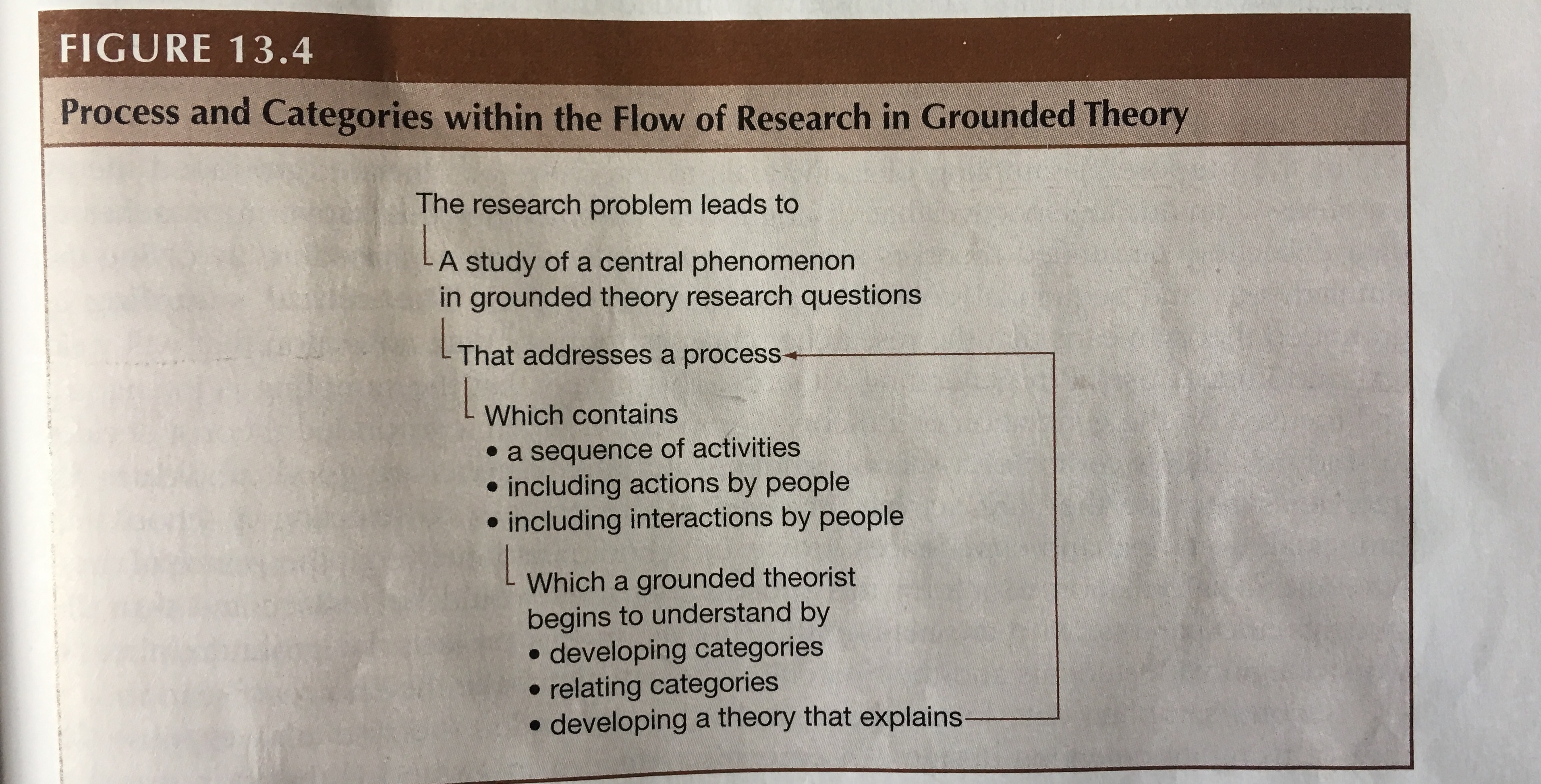
A core trait of grounded theory is its use to examine a process. A process is a sequence of actions among people. As a grounded theory research breaks down the process into steps, these steps become know as categories. The categories can be further broken down into codes. The whole procedure is shown in the picture above – Figure 13.4 (Creswell & Guetterman, 2019, p. 443).
For example, let’s say a researcher wants to develop a grounded theory about the “process of dropping out of college.” This study would involve describing the steps that lead a person to drop out of college. The various steps in this process would come from interviewing students who have dropped out of college (who have experiences in what the researcher wants to explore) to determine the order of events the precipitated dropout.
2. Theoretical Sampling
Theoretical sampling involves selecting data to collect, based on its use in developing a theory, including observations, conversations, interviews, public records, respondents’ diaries and journals, and the researcher’s own personal reflections (Charmaz, 2000, as cited by Creswell & Guetterman, 2019) . A grounded theory researcher is always seeking to find data that would be useful in the generating a theory.
Let’s come back to the example of dropout in college taken earlier. The researcher may choose to collect data from student who have dropped out, teachers, and parents. The reason for selecting these participants is that the researcher may be convinced that these participants have useful information in developing a theory.
It is important to use theoretical sampling while the theory emerges. A grounded theory researcher is constantly collecting and analyzing data simultaneously. This process is mutually beneficial because the sampling helps the analysis while the analysis helps to focus the sampling (Creswell & Guetterman, 2019, p.444-445).
Data collection does not stop until the data becomes saturated. Saturation (I will talk about this term later) is the point that new data will not provide any additional information. At what point this happens is at the discretion of the researcher.
Saturation
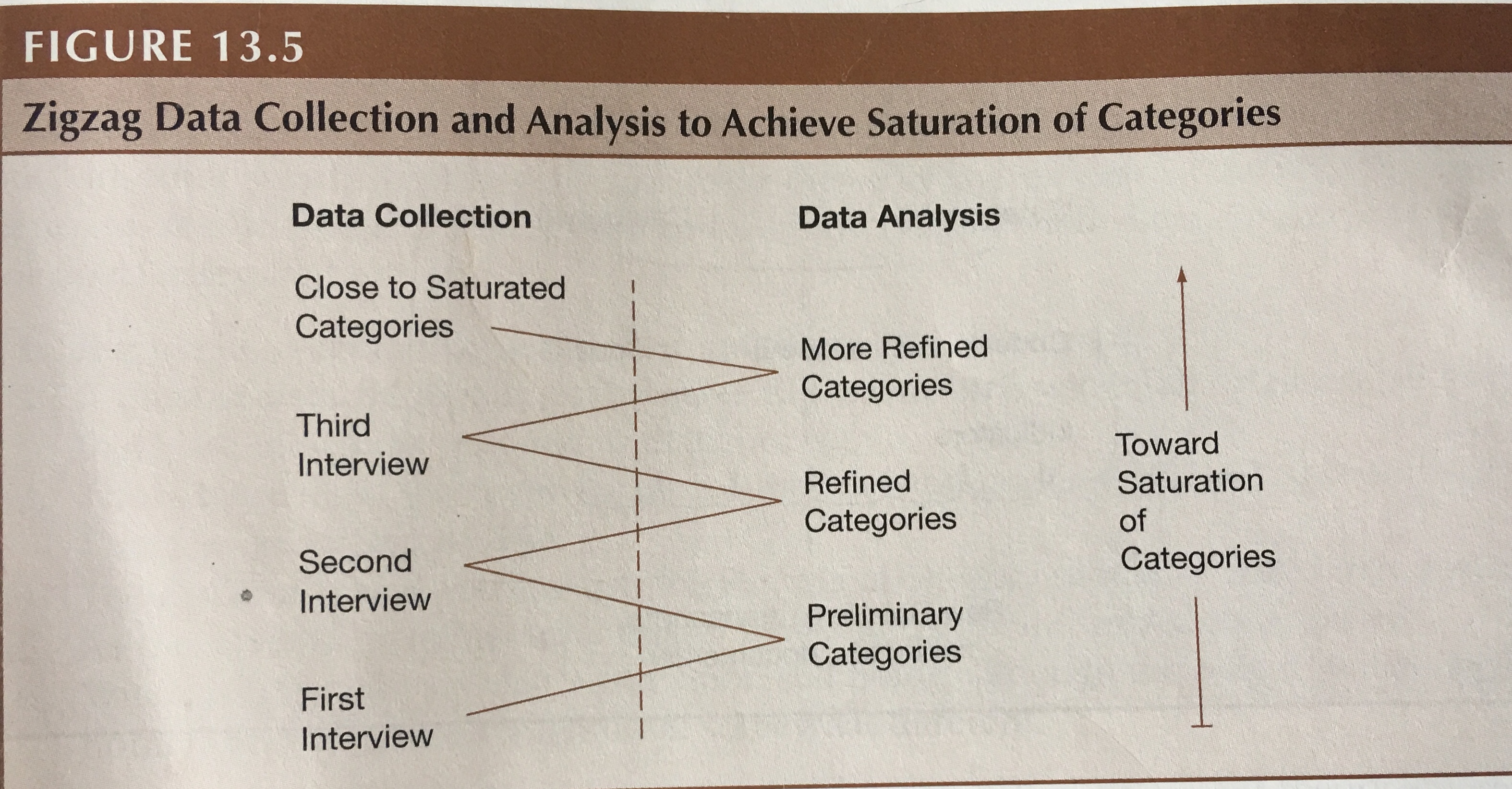
Let’s look at the picture above (Figure 13.5, Creswell & Guetterman, 2019, p. 445), the researcher would organize transcripts from the interview conducted; then the researcher would read through those transcripts to gain a general sense of the participants’ idea. After that, the researcher will start coding the transcripts and breaking them up into chunks; then the researcher describes the data in various ways. Then the researcher starts the beginning to develop categories, in which the process is called an iterative process, meaning that the researcher keeps going through the process over and over again. To reach the saturation, researchers prepare, read, code, then go through it again and again. Then the researcher conduct more interviews and more coding. Grounded theory researchers constantly collect data until they feel like that they have had enough, and then they interpret the data and start to develop categories. After that, the researcher collapse codes together to make themes. Different themes would be created and researchers keeps going through this process over and over again until they think the themes generated will describe that the central phenomenon.
3. Constant Comparative Data Analysis
We have talked about this in last post.
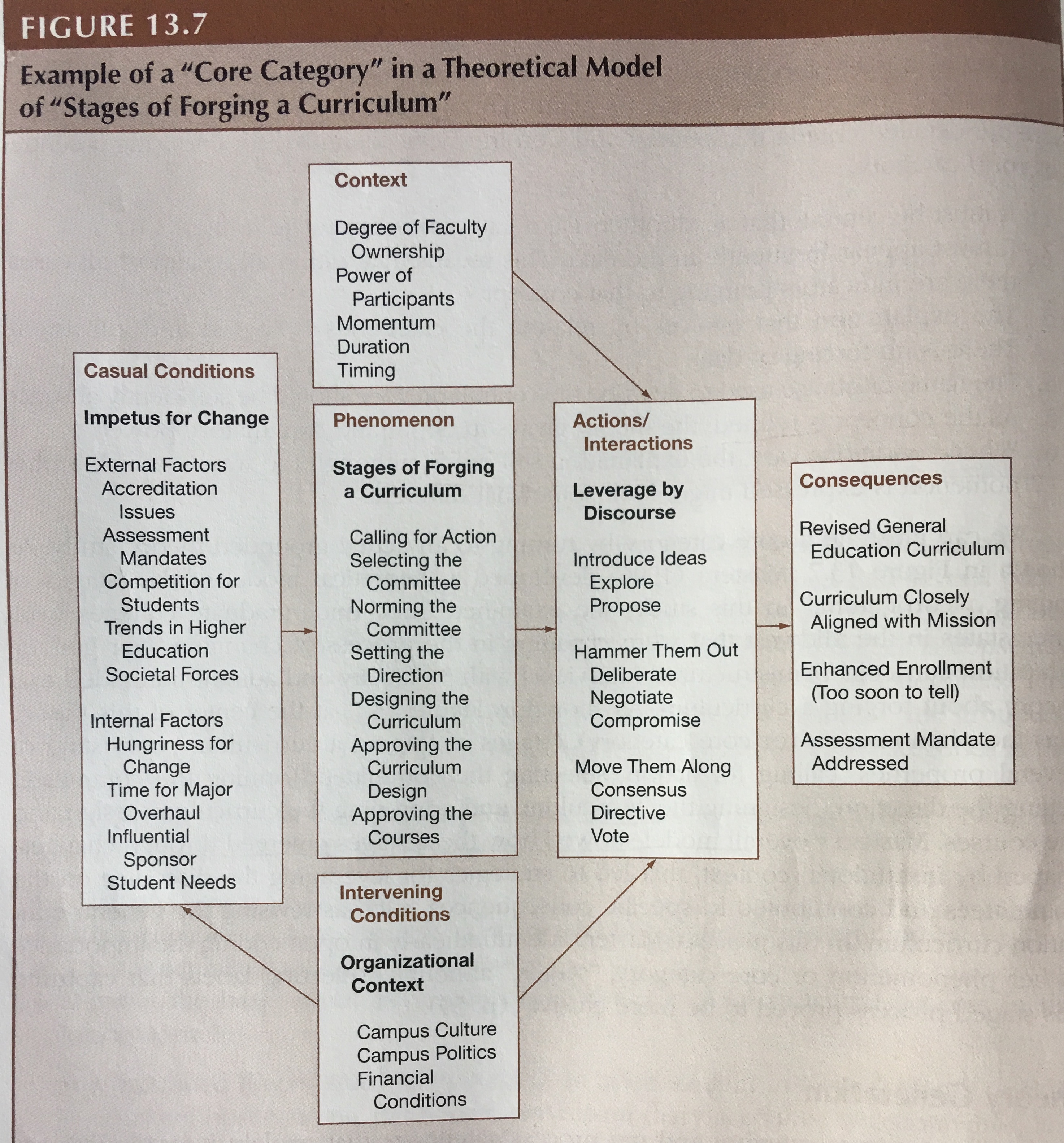
4. A Core Category
“From among the major categories derived from the data, the grounded theorist selects a core category as the central phenomenon for the theory” (Creswell & Guetterman, 2019, p.446).
Criteria for choosing a core category:
- All other major categories can relate to it
- Appears frequently in the data
- The connections between categories are logical and consistent.
- The phrase used to describe the central category should be sufficiently abstract.
- As the concept is refined, the theory grows in depth and explanatory power.
- When conditions vary, the explanation still holds, although the way in which a phenomenon is expressed might look somewhat different.
(Creswell & Guetterman, 2019).
An example of how a core category is demonstrated in a theoretical model is offered in the textbook (Figure 13.7, Creswell & Guetterman, 2019, p.448).
5. Theory Generation
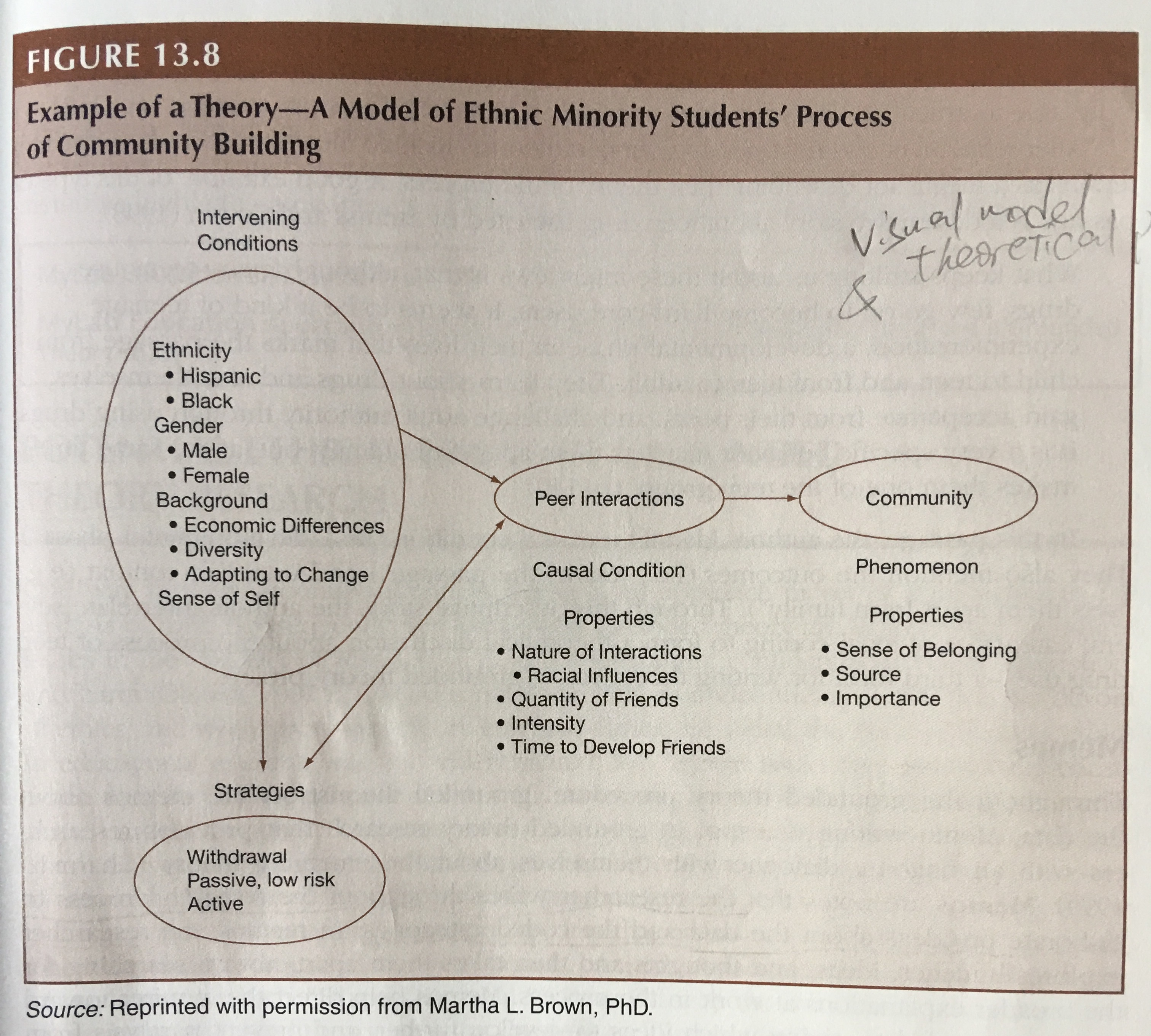
Theory appears in studies as the visual coding model or coding paradigm discussed in my previous posts; “it is an abstract explanation or understanding of a process about a substantive topic grounded in the data” (Creswell & Guetterman, 2019, p.447). Here is an example of a theory offered by the book (Figure 13.8, Creswell & Guetterman, 2019, p.449).
6. Memos
We talked about how to take memos in my last post.
References
Charmaz, K. (2000). Grounded theory: Objectivist and constructivist methods. In N.K> Denzin & Y. S. Lincoln (Eds.), Handbook of qualitative research (2nd ed., pp. 509-535). Thousand Oaks, CA: SAGE.
Creswell, J. W. & Guetterman, T. C. (2019). Educational research: Planning, conducting, and evaluating quantitative and qualitative research (6th ed.). Boston: Pearson.
Crook, T. A. (2013). A case study exploring the value and relevance of using the teaching ESL students in mainstream classrooms (TESMC) course for professional development related to teaching English to speakers of other languages with mainstream teachers of English language learners in international schools.
 Grounded Theory Design